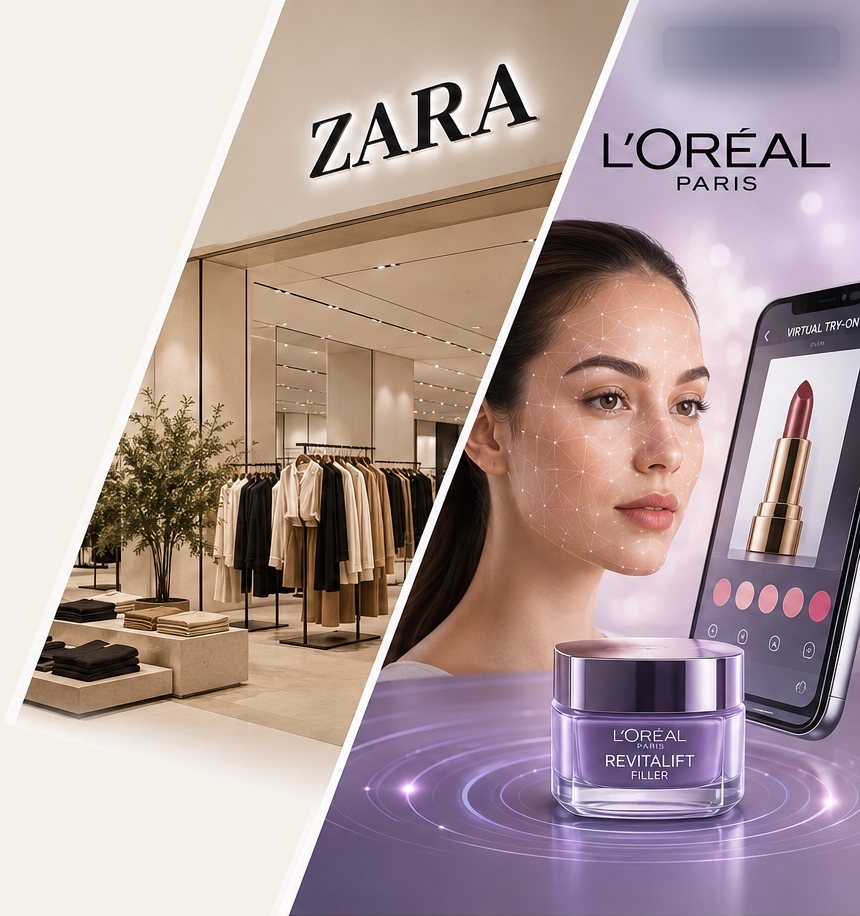
Zara storefront beside a L'Oréal virtual try-on: a model's face scanned by AR on a phone, next to a Revitalift Filler jar.
Opening
Slide 1 of 20

Learning from the Digital Vanguard: Zara & L’Oréal

A comparative case study on
buy-side and sell-side digital innovation

Course
BUSM7045
Digital Business Innovation
Student
Huynh The Anh
s3945678
Date
July 2026
Instructor
Dr. (Name)
Western Sydney University BUSM7045 – Digital Business Innovation Individual Case Study Presentation
Scroll or click to continue
Agenda

Four Questions

  • Framework — buy-side vs sell-side × Ten Types of Innovation
  • Q1 — the single most valuable insight
  • Q2 — applying the lessons in my own work
  • Q3 — the start-up opportunity it reveals
  • Q4 — what it means for my career
Framework

Buy-side vs Sell-side × Ten Types of Innovation

  • Buy-side = upstream — sourcing, production, logistics
  • Sell-side = downstream — marketing, personalization, experience
  • Ten Types (Keeley et al., 2013): Configuration · Offering · Experience
  • Zara → Configuration (Process + Structure + Network)
  • L’Oréal → Experience (Channel + Engagement + Service)
  • That asymmetry is the whole argument
Case Study · Zara / Inditex

Why Zara is a buy-side story

  • Inditex FY2025: sales €39.9bn · net income €6.2bn
  • 5,460 stores · 214 markets · online €10.7bn = 26.8% of sales
  • The edge is not the garment — it is the system that designs, makes and moves it faster
  • Vertically integrated, production kept close to HQ
Case Study · Zara

Core innovation (textbook era, to ~2022)

  • Vertical integration — design → manufacture → logistics → retail
  • Near-shoring — production close to HQ, fast flexible re-orders
  • ~2-week design-to-store cycle
  • Small batches + twice-weekly replenishment — scarcity, few mark-downs
  • RFID — item-level stock visibility across the network
Case Study · Zara

Post-2022 innovation

Zara Try-On — GenAI fitting

Avatar from your own photo; 43 markets, 7M+ sessions (FY2025)

SINT + ship-from-store

Every store becomes a fulfilment hub

Soft-tag technology

100% of stores; 90% of products by SS2026

Logistics mega-investment

€1.8bn over 2024–2025; ~€2.3bn capex planned for 2026

Materials / circularity

€50m textile fund; Ambercycle off-take >€70m

AI as stated strategy

CEO frames AI + diversification as growth levers (2026)

Case Study · L’Oréal

Why L’Oréal is a sell-side story

  • FY2024: sales €43.48bn · operating margin 20.0% (record)
  • E-commerce = 28.2% of sales · 37 brands, 150+ countries
  • The chemistry is stable — the battleground is discovery, diagnosis, personalization
  • Reframed itself as a “Beauty Tech” company
Case Study · L’Oréal

Core innovation (textbook era, to ~2022)

  • “Beauty Tech” positioning — from 2018
  • ModiFace (2018) — first tech acquisition; AR try-on across brands
  • SkinConsult AI (2019) — AI skin diagnostic
  • Perso (CES 2020) — personalized 3-in-1 beauty device
  • Colorsonic / Coloright (CES 2022) — AI hair-colour devices
Case Study · L’Oréal

Post-2022 innovation

  • Beauty Genius (CES 2024) — GenAI beauty advisor
  • Aesop (2023)US$2.525bn, largest-ever acquisition
  • CES hardware — AirLight Pro (CES 2024) · Cell BioPrint (CES 2025)
  • IBM (16 Jan 2025) — AI foundation model for cosmetic formulation
  • NVIDIA (2025) · CreAItech GenAI content platform · Noli marketplace
Q1 · Insight

The single most valuable insight

  • Operating-model innovation is harder to copy than product innovation
  • Features can be bought; systems of interlocking choices resist cloning
  • Zara’s moat = process & speed — a demand-sensing loop
  • L’Oréal’s moat = data & personalization — a deepening flywheel
  • Same logic, opposite ends: both build a compounding system
Q1 · Comparison

Two paths to a moat

DimensionZara (buy-side)L’Oréal (sell-side)
Value-chain focusSupply chain, production, logisticsMarketing, discovery, personalization
Ten-Types clusterConfiguration (Process, Structure, Network)Experience (Channel, Engagement, Service)
Core moatSpeed / operating modelProprietary data / personalization
Signature old asset~2-week design-to-store, RFID, near-shoringModiFace AR, SkinConsult AI
Signature new assetZara Try-On, SINT ship-from-store, €1.8bn logisticsBeauty Genius, CreAItech, IBM formulation model
What is hard to copyThe whole timing loopThe accumulated customer data
Key metricOnline 26.8% of €39.9bn sales (FY2025)E-commerce 28.2% of €43.48bn sales (FY2024)
Q2 · Application

Applying the lessons

  • Persona: an IT professional building an AI side business
  • Zara lesson — speed: compress the idea→live cycle
  • L’Oréal lesson — personalization: first-party data, deeper retention
  • Neither firm was “born digital” — both retrofitted
Q2 · Action Plan

12-month action plan, with metrics

Months 1–3 — Zara loop (speed)

Ship a minimal AI product. Cycle time < 2 weeks

Months 4–6 — L’Oréal loop (personalization)

Capture first-party data. Personalization rate ≥ 60%

Months 7–9 — Retain

Re-engage on behavioural data. 30-day retention ≥ 30%

Months 10–12 — Compound

Close the loop. Halve cycle time again

Metrics dashboard

Cycle time · personalization rate · 30-day retention

Q3 · Opportunity

The start-up opportunity

  • Both giants retrofitted into tech companies
  • Reusable formula: proprietary data + fast iteration
  • A solo builder starts digital-native — no legacy to carry
  • Compete in niches too small for giants, data-rich enough to compound
Q3 · Niches

Specific niches

  • Dermocosmetic education (Vietnam) — an AI skincare-literacy advisor
  • Personal-styling AI — avatar try-on + wardrobe recommendation
  • Fashion resale / circularity — authentication, pricing, matching
  • Each owns a proprietary data loop and rewards fast iteration
Q4 · Career

The career-lens shift

  • From “IT specialist” → “digital business builder”
  • Value = connecting technology to a business model
  • Scarce skill: deciding which capability becomes a defensible system
  • Move from implementer to designer of the model
Q4 · Roadmap

Skills roadmap (2025–2027)

2025 — AI application

Ship real AI features; GenAI fluency

2026 — Data literacy

Capture and compound a proprietary data asset

2027 — Business-model design

Unit economics, moats, go-to-market

Direction of travel

Technical depth → data leverage → business design

Conclusion

Key takeaways

  • Innovation is more than product — Configuration & Experience carry the moat
  • Zara compounds speed; L’Oréal compounds data — opposite ends, same strategy
  • Systems are harder to copy than features (Q1)
  • Builder formula: fast iteration + proprietary data (Q2, Q3)
  • Career: IT specialist → digital business builder (Q4)
References

Sources

Author–date style; full URLs held in the accompanying source list.

  • Inditex (2026) FY2025 Results. Available at: inditex.com [Accessed 16 Jul 2026].
  • Inditex (2025) FY2024 Results. Available at: inditex.com.
  • Inditex (n.d.) Our Approach (production, near-shoring, SINT, RFID). Available at: inditex.com.
  • Sourcing Journal (2024) Inditex/Zara logistics expansion (€1.8bn).
  • FashionUnited (2024) Inditex €1.8bn 2024–25 investment plan.
  • Sourcing Journal (2024) Inditex–Mundi Ventures €50m textile-innovation fund; Circ, Ambercycle, Galy, Infinna.
  • Inditex (2024) Three-year agreement to buy cycora recycled polyester (>€70m).
  • Reuters via Investing.com (2026) Inditex CEO on diversification and AI.
  • L’Oréal Finance (2025) 2024 Annual Results and Annual Report 2024 (sales €43.48bn; 20% margin; 28.2% e-commerce; 37 brands; 150+ countries).
  • L’Oréal (2018) L’Oréal acquires ModiFace.
  • L’Oréal (2019) L’Oréal and ModiFace — AI-powered skin diagnostic (SkinConsult AI).
  • PR Newswire (2020) L’Oréal introduces Perso at CES 2020.
  • L’Oréal (2022) Beauty Tech innovations ahead of CES 2022 (Colorsonic/Coloright).
  • L’Oréal (2023) Agreement with Natura &Co to acquire Aesop (US$2.525bn); CNBC (2023).
  • L’Oréal (2024) AirLight Pro (CES 2024); L’Oréal Annual Report 2024 Beauty Tech champion (Beauty Genius).
  • L’Oréal (2025) Cell BioPrint (CES 2025).
  • IBM Newsroom (2025) IBM and L’Oréal to build first AI model for sustainable cosmetics.
  • L’Oréal (2025) L’Oréal and NVIDIA collaborate to supercharge beauty with next-gen AI.
  • Keeley, L., Pikkel, R., Quinn, B. and Walters, H. (2013) Ten Types of Innovation: The Discipline of Building Breakthroughs. Hoboken, NJ: Wiley.
Thank You

Questions welcome

“Features get copied; systems compound — Zara compounds speed, L’Oréal compounds data.”